
Barber County VINE Coverage
Kansas VINELink is the state entry point for VINE, a free, confidential and voluntary custody-information and notification service. Kansas Attorney General material describes the program as a joint effort with the Kansas Sheriffs’ Association and state partners. It provides round-the-clock access to information received from participating county jails. A Barber County Jail record can appear when that agency is reporting the person through VINE.
The boundary is strict. Kansas VINE covers adults in participating Kansas county jails, but it does not include offenders housed in Kansas Department of Corrections prisons. VINE is also not the federal Bureau of Prisons locator or the ICE detainee locator. Each system follows its own population. Choosing the correct system prevents a missing result from being mistaken for release.
VINE also differs from a county release log. It watches reported custody events for a selected record and offers notice choices. It does not certify a past release time, create a complete Barber County booking history, or replace a court disposition. The county record answers what the jail recorded. The court file answers what a judge ordered. VINE helps a registrant learn that the participating agency reported a change.
Search One Barber County Inmate
Begin with the person, not a broad list. The live Kansas portal supplies its current name and identifier options. An offered ID is useful when known, but it should not replace identity checks. Similar names can produce more than one record, and selecting the wrong agency record can lead to an alert about someone else.
- Open the official Kansas VINELink state page and enter the first and last name as accurately as possible.
- Add an offered identifier when it is known. Review all likely matches before opening a record.
- Compare the date of birth, booking or custody agency, and any other live identifiers shown.
- Open the matching record. Read the exact custody wording, reporting agency and last-update information.
- If the status changed, contact the reporting jail to learn whether the event was release to the community or transfer.
A broader Barber County released inmate search may be needed when VINE has no matching county-jail record. That search follows the person to the court, KDOC, BOP or ICE rather than forcing every case through one portal.
Barber County VINE Record Fields
VINE displays custody information supplied for the selected person. Exact labels can change with the live interface and reporting agency. Preserve the wording rather than converting a status into a broader claim. “Released,” for example, can establish that the reporting agency recorded a custody change, but the Barber release sheet is needed to distinguish bond, time served, another community disposition or a transfer.
| Field | How to read it |
|---|---|
| Name and identifiers | Use them to separate people with similar names before selecting a record. |
| Custody status | Read the exact live wording. Do not paraphrase it as “free.” |
| Custody agency | Shows which participating agency supplied the event and should confirm it. |
| Last update | Indicates data timing, not the certified time of physical release. |
| Notification options | Shows which events and delivery methods the live record currently offers. |
The manifest capture of the Kansas VINELink search and notification path illustrates the portal used for a specific-person check.
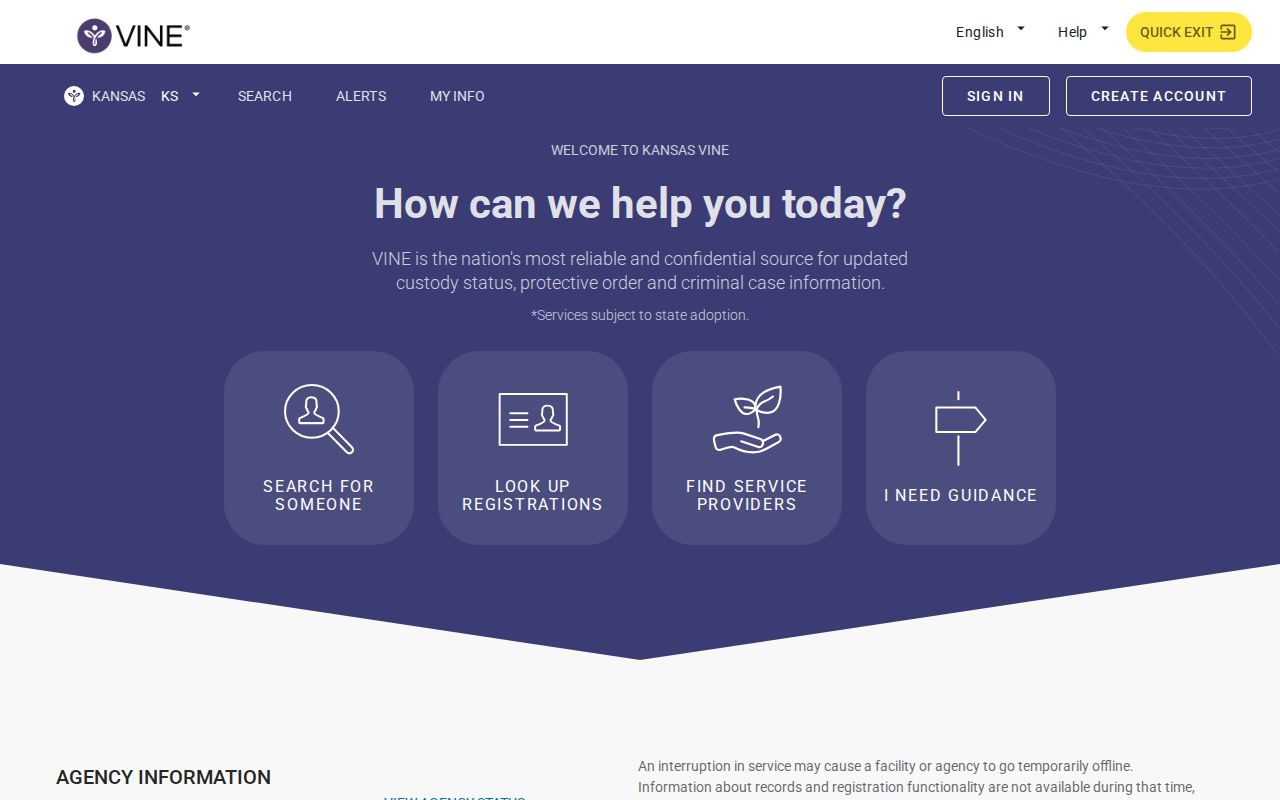
The screen is a navigation aid. Its status should be paired with the agency record whenever the event’s legal or physical meaning matters.
Set Barber County Release Alerts
After selecting the correct county-jail record, use “Get Notified” or the equivalent live option. Registration attaches notice choices to that person. Available events may include release or another custody change, and current delivery channels can include telephone, text or TTY, and email. The live screen controls which choices are offered.
- Select the correct Barber County record and choose the notification option.
- Choose the offered custody event or events that matter.
- Select an available delivery channel and enter the phone number or email address carefully.
- For telephone notice, create the four-digit PIN when prompted and keep it private.
- Complete any confirmation step. Update contact details later if the phone number or email changes.
Telephone and email confirmation are not the same. Kansas material says the recipient enters the chosen PIN to acknowledge an automated telephone call. Email notification does not use that telephone PIN. An unanswered call is not proof that no event occurred, and automated calls may repeat until acknowledged under the service rules.
Keep the alert’s time and wording. Then call the reporting facility. That short record helps staff identify the event without turning the alert itself into a certified release document.
Registration is confidential, but careful handling still matters. Do not share a telephone PIN or portal credential. Select only the correct person after checking the agency and identifiers, since notification is linked to that chosen record. If a phone number or email address changes, update it through the service. A valid registration sent to an old contact cannot provide timely notice.
Confirm a Barber County Release
Barber County Jail is the local source for its own physical release or outward transfer. KDOC’s official jail directory lists the jail at 124 E. Washington Avenue in Medicine Lodge and gives 620-886-5678 as the jail number. Barber County’s official sheriff page lists 620-930-2590 for the Sheriff’s Office at the same address. The labels differ, so both numbers retain their stated roles.
Ask whether the person is presently held and whether the last event was a community release or a transfer. Telephone disclosure may be limited. If documentary proof is needed, request the named booking’s actual release date and time plus the disposition or destination through the Barber County KORA process. VINE supplies the fast notice layer; the jail entry supplies the confirmation layer.
- Community release
- The person leaves the reporting jail without an immediate transfer to another custodian.
- Transfer
- Custody moves to another jail, KDOC, BOP, ICE or another authority. It is not release into the community.
- Discharge
- A sentence or supervision obligation ends. It is different from merely leaving a jail building.
Note: A court order may authorize release, but only the jail record establishes when staff completed release and whether another hold changed the outcome.
Barber VINE Versus KDOC Records
A transfer from Barber County Jail to KDOC can make the county-jail VINE record change while custody continues. Move to KASPER, the Kansas Adult Supervised Population Electronic Repository. KASPER covers people and cases tied to KDOC-operated or KDOC-funded programs. It may show status, cases, movements, supervision, images and sentence information.
KASPER is updated on working days, not continuously. It is not a complete Barber County booking archive, and its disclaimer says community-corrections events after April 21, 2021 are not displayed during data modernization. A state record can remain useful after prison release because parole, postrelease supervision and final discharge are distinct KDOC events.
Read KASPER in sequence. First match the KDOC number, name and available identity details. Next confirm the case and county. Then review present custody or supervision, housing and movement history, any parole-office assignment, and sentence or discharge entries. A parole-office assignment supports that the person left the prison building for community supervision, but it also shows that KDOC authority continues.
| Person or event | Correct channel |
|---|---|
| Participating county-jail custody or alert | Kansas VINE, then the reporting jail |
| KDOC prison, parole or postrelease status | KASPER and KDOC |
| Federal prison sentence | BOP Inmate Locator |
| ICE detention | ICE Online Detainee Locator |
KDOC Alerts After Barber Transfer
KDOC Victim Services maintains a separate notification registration form for a person in a KDOC facility or under KDOC supervision. It excludes ordinary county-jail, probation and community-corrections cases outside KDOC. The form asks for registrant information, the offender’s name, county of conviction, case number and relationship. A separate form is required for each offender.
This path complements Kansas VINE. It does not replace the county-jail alert. KDOC Victim Services lists 1-866-404-6732 and VictimWitness@doc.ks.gov. Use it after the record establishes KDOC custody or supervision, not simply because a Barber County VINE search is blank.
Official Kansas sources publish conflicting VINE telephone spellings. The Attorney General landing page showed 1-866-574-7463, while a 2026 announcement and fact sheet showed 1-866-574-8463 when researched. The live official page or VINELink portal should be checked instead of choosing one silently.
Barber Release Versus Registry Status
The Kansas Bureau of Investigation Registered Offender Search has a narrow statutory purpose. It covers defined sex, violent and drug offender categories when Kansas registration criteria apply. A person may appear while living in the community, but the registry does not list everyone released from Barber County Jail or KDOC.
Presence establishes a registration record, not the date or reason for jail release. Absence can mean the person is not subject to registration. It does not establish that the person remains incarcerated. Use the registry only when its defined coverage applies, then use the jail, court or KDOC record to answer the release question.
When Barber County VINE Fails
Search again with careful spelling and any offered identifier. Confirm that Kansas and the expected custody agency were selected. If Barber County Jail is the expected reporter, call the jail. A record can be absent because of participation, data transfer, intake timing or a mismatch, and none of those conditions alone proves release.
If the jail identifies a transfer, follow the named custodian. Search KASPER after KDOC intake, BOP for a sentenced federal prisoner, or ICE’s locator for ICE detention. For an exact historical release time, use the Barber County KORA request. The agency that created the custody event remains the strongest source.
The Barber District Court record is another check when the reason for release is disputed. A bond order, dismissal, sentence or other journal entry can explain the legal authority. Yet an order does not prove when staff finished processing or whether a detainer, meaning another agency’s hold, prevented community release. Pair the court event with the jail’s actual release or transfer entry.