
Barber County Projected Versus Actual Release
A projected date answers what the current sentence calculation indicates. An actual release record answers what occurred, when staff completed the release, and whether the person went to the community or another custodian. The two records serve different roles. A future date can change. An executed movement or release entry documents an event that already happened.
KASPER may use the label “Anticipated release date.” Older material can use “Earliest Possible Release Date,” while a specific record may show a conditional-release, parole-eligibility, or maximum date instead. Preserve the exact label. Each one carries a different legal meaning. A parole-eligibility date, for example, may only mark when the Prisoner Review Board can consider a person.
A pretrial Barber County Jail detainee usually has no computed sentence-release date. Bond may authorize release, yet processing, a detainer, or another court order may prevent a community exit. The signed order and the jail’s actual release entry should be compared. Missing from a current roster does not settle the issue because transfer and data delay remain possible.
Find a Barber County Projected Date
Begin by separating county custody from state imprisonment. KASPER covers people and cases associated with KDOC programs. It is not a complete Barber County Jail archive. Someone whose case remained local may have no KASPER record even after a jail sentence. Conversely, a KDOC entry can remain online after prison release because parole, postrelease supervision, and discharge are part of its history.
- Identify the current custodian through the jail, court case, or known KDOC number. Do not assume a local arrest means current county custody.
- For a state prisoner, accept the disclaimer at KASPER, search by KDOC number or name, and match identity and case details.
- Read the status, custody or supervision level, housing, movement history, sentence information, and the exact date-field label together.
- For a Barber County sentence, obtain the sentencing journal entry through the court and ask the jail for the calculation or actual release record.
- Recheck close to the displayed date. For a disputed KDOC calculation, contact the Sentence Computation Unit at 785-296-3317.
- After the date passes, look for a movement to supervision, a discharge entry, or the jail’s dated release and disposition record.
The statewide corrections record can include the KDOC number, name, birth date, physical details, conviction county and case, present housing, facility movements, parole-office location, supervision level, and sentence data. Those fields protect against matching the wrong person and help distinguish prison exit from sentence discharge.
The Barber County Clerk of District Court is at 118 E. Washington in Medicine Lodge and keeps public hours Monday through Friday, 8 a.m. to noon and 1 to 4 p.m. Its court record may show the sentence, jail credit, later correction, probation order, or revocation that explains the date. Barber County Jail, at 124 E. Washington Ave., can address its own custody and release entry at 620-886-5678.
Note: KASPER updates on working days, so a same-day movement may occur before the public state record changes.
Read Barber County KASPER Dates
KASPER’s mandatory disclaimer is part of the lookup. It warns that status can change between an update and the time a record is viewed. It also says community-corrections events after April 21, 2021 are not displayed. A silent result therefore cannot prove a Barber County release, a probation discharge, or the absence of a later supervision event.
The official KASPER search is shown in the captured public interface below.
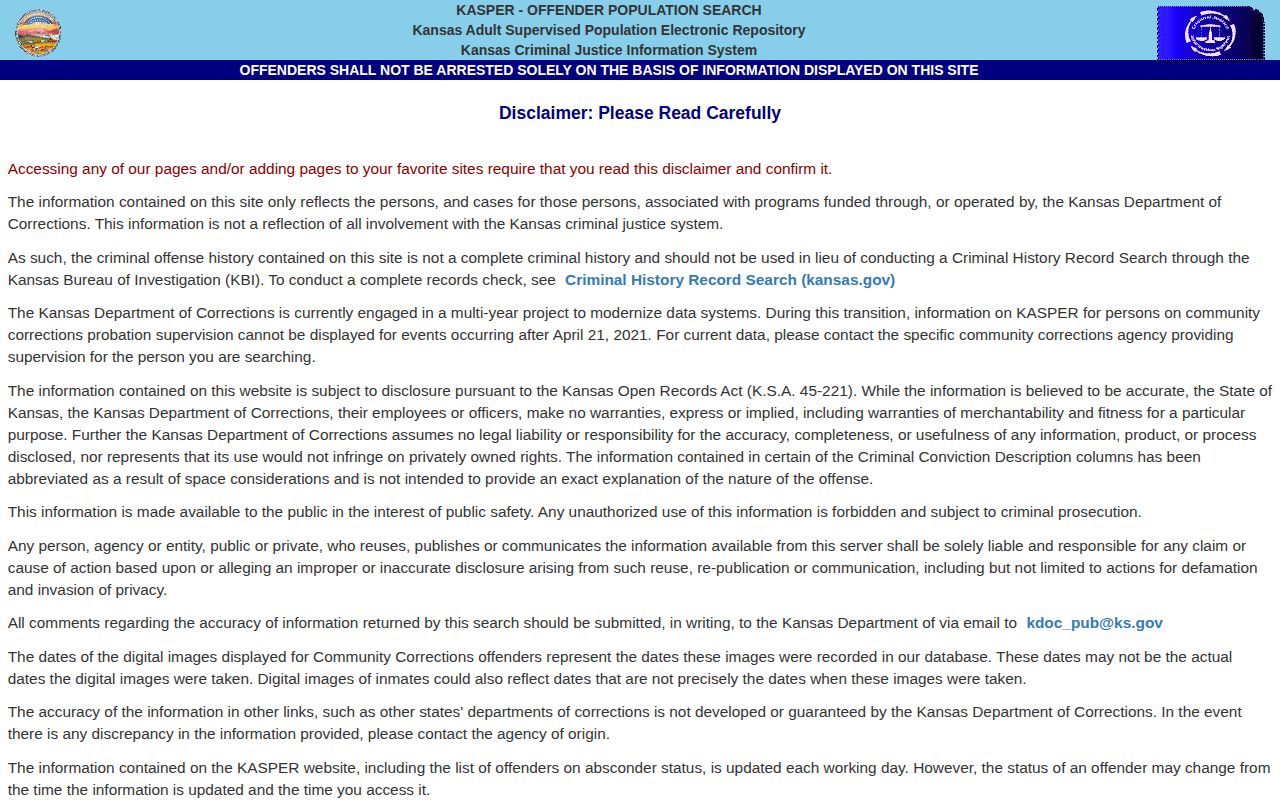
Use the screen to reach the matching person, then cite the individual record’s live label rather than treating the screenshot as a universal field list.
| Field or entry | How it helps | Limit |
|---|---|---|
| KDOC number and identity | Confirms the correct person | A name match alone is weak |
| County and case | Links the sentence to Barber County or another venue | Other cases may also control |
| Custody or supervision level | Shows prison, parole, postrelease, or another status | Updated on working days |
| Movement history | Shows institutional and community transitions | A future date is not a movement |
| Anticipated or other date label | States the current calculation or eligibility point | The label and sentence type control its meaning |
Barber County Good-Time Limits
Kansas does not impose one blanket 85-percent rule on every person. For most determinate crimes committed on or after July 1, 1993, K.S.A. 21-6821 caps good-time reduction at 15 percent of the prison portion. That cap creates the common shorthand that a person serves about 85 percent if all available credit is earned and retained. It is a ceiling on credit, not a promise of a specific day.
Specified categories can have a 20-percent maximum. The statute includes nondrug severity levels 7 through 10 for crimes on or after January 1, 2008, drug severity levels 3 through 4 for the January 1, 2008 through June 30, 2012 period, and drug severity levels 3 through 5 for crimes on or after July 1, 2012. Designated program credit can apply to defined eligible sentences and circumstances, with a statutory cap of 120 days. Eligibility, exclusions, program completion, conduct, forfeiture, and restoration all matter.
The official Kansas good-time law is captured below from the Legislature’s published statute page.
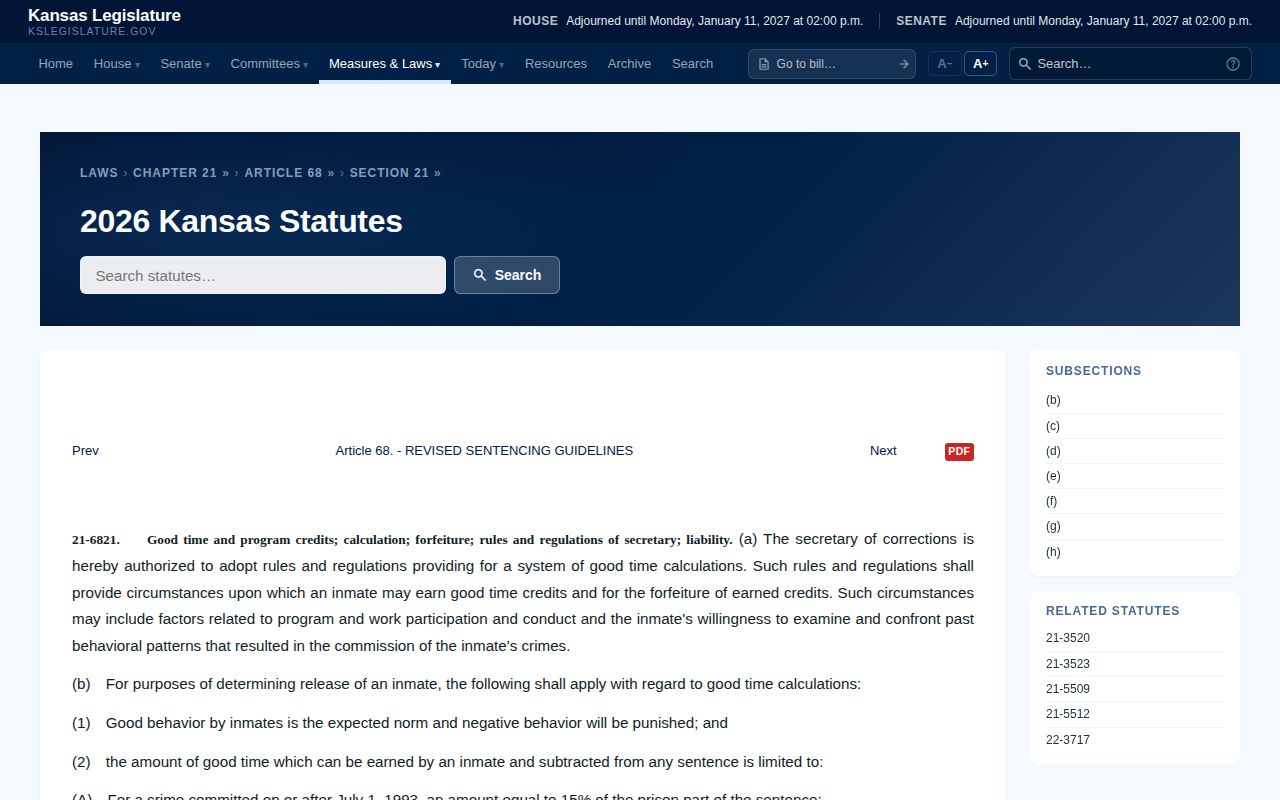
The statutory categories explain inputs to KDOC’s calculation. They do not authorize a personal calculation based only on an offense name.
Good time must not be transferred mechanically to a Barber County Jail sentence. Barber County publishes no local good-time rule, weekend-release rule, or projected-date calculator. The sentencing journal entry, lawful jail credit, local authority, and actual jail record govern. Ask the jail and court about the exact case rather than subtracting 15 percent.
Barber County Sentence Date Paths
Determinate, indeterminate, and off-grid sentences produce different questions. Most Kansas crimes committed on or after July 1, 1993 use determinate sentencing. Under K.S.A. 22-3717, many such prisoners are not eligible for discretionary parole. They leave the prison portion for mandatory postrelease supervision. A “parole hearing date” is therefore the wrong release-date field for many modern sentences.
Pre-guidelines indeterminate cases work differently. K.S.A. 22-3725 and the Prisoner Review Board framework can make the minimum term, retained good time, and parole eligibility relevant. Conditional release is another older-law concept tied to the maximum term and retained credit. It is not the same as a favorable discretionary parole decision, and it can still lead to supervision until maximum expiration.
Off-grid, life, and specially sentenced crimes require the exact subsection and offense date. Life without parole is ineligible by definition. Other life and off-grid cases may carry mandatory minimums that are not reduced through the ordinary determinate-credit path. Consecutive terms can aggregate, while prior-custody credit, revocation time, and later court action can change the official result.
- Determinate sentence
- A fixed prison term governed by guidelines and applicable credits, often followed by mandatory postrelease supervision.
- Indeterminate sentence
- An older-style minimum-to-maximum term in which parole eligibility and Board action may matter.
- Off-grid sentence
- A sentence outside the standard guideline grid, controlled by its specific statute.
- Conditional release
- An older-law release point tied to the maximum term and retained good time, with authority still continuing.
Why Barber County Release Dates Change
A displayed future date is the product of the records and rules known to the calculating agency. Later facts can move the projection or change the type of event that occurs on that day. The public record may not reveal every input, so an apparent mismatch should go to the court, jail, or KDOC Sentence Computation Unit.
| Factor | Possible effect | Where to verify |
|---|---|---|
| Earned credit or program credit | May reduce the prison portion within statutory limits | KDOC sentence record |
| Credit forfeiture or restoration | May move a projected date later or earlier | KDOC calculation and discipline record |
| Jail-time credit | Changes credited time already served | Judgment and official calculation |
| Consecutive cases | Can aggregate terms | All judgments and KASPER cases |
| Detainer or hold | May send the person to another custodian instead of the community | Holding and requesting agencies |
| Revocation or warrant | Can interrupt supervision or add custody time | Court, KDOC, and movement history |
| Corrected court order | Can alter the sentence or credit inputs | Filed journal entry and Sentence Computation |
A hold is especially important in Barber County jail research. A court order may authorize release in the local case, but another county, KDOC, federal agency, or immigration authority may receive the person. The Barber jail disposition and receiving agency record distinguish transfer from community release.
Note: Never promise an early weekday release when a date falls on a weekend or holiday because Barber County publishes no such local rule.
Barber County Parole Eligibility Dates
The Kansas Prisoner Review Board calendar is not a list of everyone who will leave prison. It applies to cases that remain parole eligible. Its public-comment material is posted by month, and the listed people may have hearings later and possible eligibility after that. A scheduled hearing is not a grant. A grant is still not the actual gate-release time.
The official monthly public-comment schedule shows the Board’s prospective process.

Use the schedule with KASPER’s KDOC number, sentence status, and later movement history. Board terms also matter: parole means suitability was found, continue postpones a decision for more work, and pass denies parole for an interval.
For a modern determinate sentence, the likely next legal stage is mandatory postrelease supervision rather than a discretionary parole grant. That continued status can be checked on the Barber County post-release supervision page after the prison movement occurs.
Confirm Barber County Actual Release
Save four items from an online date: the exact field label, the access date, the KDOC number, and the current status. Confirm whether the judgment is determinate, indeterminate, or off-grid. Check for multiple cases, consecutive terms, warrants, detainers, and later orders. Do not subtract a credit percentage yourself to announce a date.
Near the projection, recheck KASPER on a working day. If the judgment and public record conflict, call KDOC Sentence Computation at 785-296-3317. Afterward, look for a movement into parole or postrelease supervision or a final discharge entry. For a local sentence, obtain the Barber County Jail release date, time, and disposition and compare them with the court case.
Kansas VINE can send custody-change notices for participating county jails, but state sources say it does not cover KDOC prisoners housed in state prisons. The resolved VINE inmate check can support a Barber jail inquiry, while KDOC’s own record and notification process are the state-prison routes. An alert is a prompt to verify, not a certified historic release sheet.
Public Record Search
Sponsored Results