
Understanding Barber County Releases
A person leaving Barber County Jail may be released on bond or recognizance, finish a local sentence, receive credit for time served, have charges dismissed, or leave under a court order. Those events can place the person in the community. An outgoing jail entry can also record transfer to the Kansas Department of Corrections, another county, a hospital, the U.S. Marshals Service, or immigration custody. A transfer changes custodians. It does not establish freedom from confinement.
The distinction controls the search. Barber County and the Sheriff operate the local jail, while KDOC expressly does not administer Kansas county jails. A local booking and release record is therefore the first source for a person whose case stayed at Barber County Jail. KASPER becomes relevant when the jail identifies a transfer to KDOC or the person served a state-prison sentence. Federal and immigration custody each require their own locator or records path.
| Outgoing event | Meaning | Next record |
|---|---|---|
| Bond or recognizance | Release under stated court or bond terms | Jail release entry and court bond order |
| Time served or sentence completion | Local confinement ends under the sentence | Jail record and sentencing case |
| Dismissal or court order | Legal authority supports release | Court filing plus actual jail release time |
| Transfer to KDOC | State custody begins after local custody | KASPER after intake |
| Other agency transfer | Another county or federal custodian takes over | Receiving agency and relevant court |
Barber County Release Record Fields
Barber County has not published an online release-record field dictionary. The items below are fields to request from an existing booking or release packet, not a promise that every field appears on one form or is open in every case. The key pair is the actual release date and time plus the disposition or destination. Together they show when the local custody event ended and whether the person entered the community or moved to another custodian.
| Field | What it shows |
|---|---|
| Full name and identifying details | Distinguishes the correct person from a similar name. |
| Booking number | Connects the response to one jail episode. |
| Booking date and time | Shows when local custody began for that booking. |
| Arresting agency and charges | Points to the case and authority behind detention. |
| Bond or court authority | Explains the legal basis for an outgoing event. |
| Actual release date and time | Records when jail staff completed the event. |
| Disposition or destination | Separates community release from transfer. |
| Booking photograph | Must be requested expressly and may be subject to disclosure limits. |
The jail record and court file answer different parts of the question. A court order may authorize bond, dismissal, probation, or release, yet it does not prove the exact moment jail processing ended. Another hold may also affect departure. Match the public order with the jail’s actual time and disposition. For a KDOC sentence, read KASPER’s status, movements, sentence data, and supervision information together rather than relying on one date.
Request Barber County Release Records
Barber County posts a Kansas Open Records Act request form. It asks for requester information, a description of the records, signature, and date. A focused description should name the person, give an approximate booking date or case number, and request the booking sheet plus the release or discharge entry showing actual date, time, and release or transfer disposition. Ask for electronic copies if available and a cost estimate before work starts.
- Call the jail first to confirm the correct name, approximate booking, and whether the last event was release or transfer.
- Describe existing records rather than asking staff to answer a broad question or create a new report.
- Request the booking sheet, actual release date and time, disposition or destination, and photograph if needed.
- Send the county form by the current method confirmed with the Sheriff’s Office. No dedicated sheriff KORA email is published.
- Review the estimate before authorizing work, then compare the response with the public court case.
The county form states that a response will be made by the end of the third business day. That response may produce records, quote time and cost, seek clarification, or explain a delay or denial. It is not a universal three-day production promise. KORA applies to records that exist and does not require the county to build a custom release list.
The Barber County public-notice page is the official starting point for the current request materials.
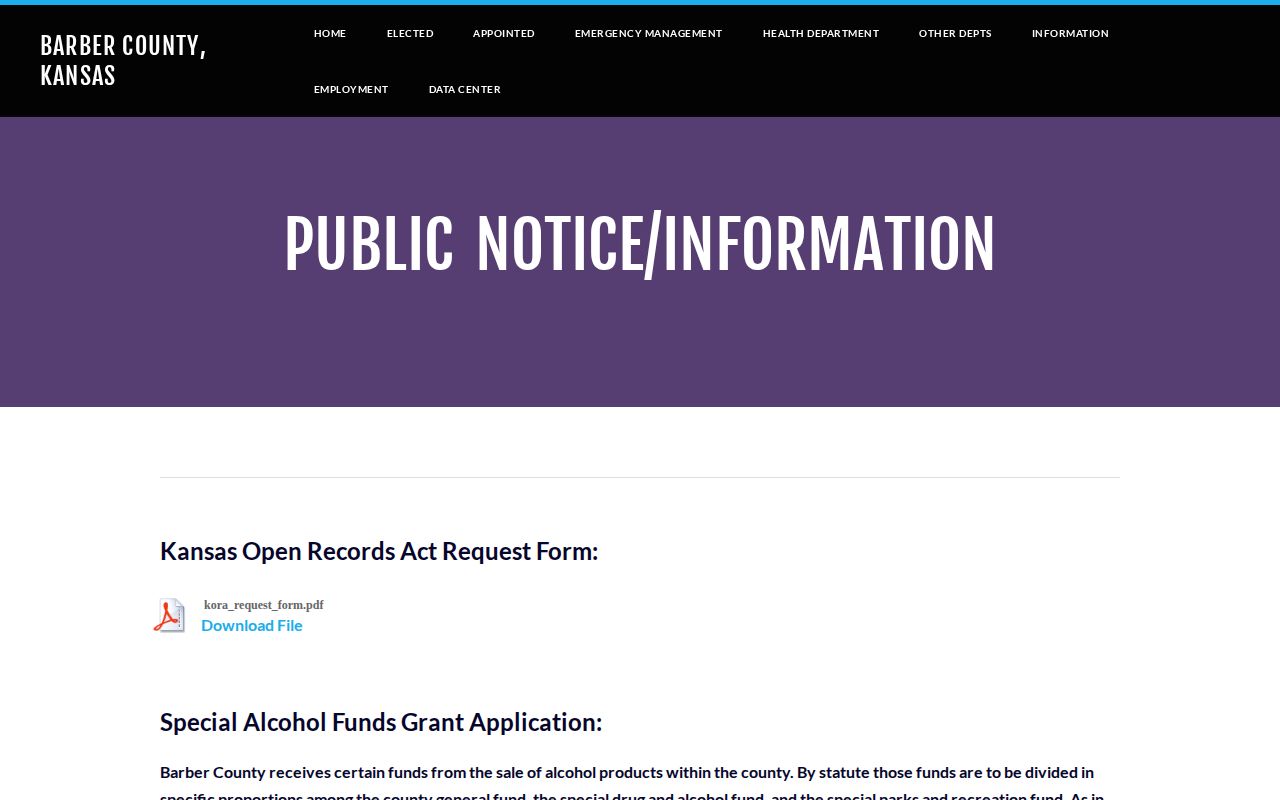
The county page links the local release inquiry to Barber County’s KORA process when a phone check is not enough.
Barber County Release Record Fees
Barber County’s January 2025 form publishes general charges. Black-and-white copies are listed at $0.25 per page, color at $0.50 per page, plan or plat pages at $8, and a CD or DVD at $2. Staff time is listed at $15 per hour for clerical work, $25 per hour for research, and $40 per hour for information technology. Other staff, postage, and added costs may be charged at the amounts stated on the form, and departments can have additional schedules.
These are general KORA rates. They do not mean a release sheet or booking image always costs one page rate, nor do they guarantee disclosure. Search time, review, redaction, format, and delivery can change the estimate. The county may require estimated fees in advance and must provide an estimate on request. A named booking and narrow date span are more precise than a demand for all jail material.
Barber County Release Law and Retention
The Kansas Open Records Act, K.S.A. 45-215 through 45-223, starts from access to nonexempt public records while preserving many exemptions. K.S.A. 45-218 addresses inspection, 45-219 permits reasonable fees, 45-220 governs procedures, and 45-221 identifies records that may be closed. Juvenile, medical, investigative, victim, and protected personal material may require withholding or redaction. An agency does not have to create a record that does not exist or replace a record response with an explanation.
No Barber County online archive or published release-record retention period was found. A missing web result therefore says nothing reliable about whether the underlying agency record still exists. State and court schedules may govern copies held by each office, but no one universal term should be assumed. Ask for a named record and allow the custodian to identify what remains responsive.
The form also cites K.S.A. 45-230, which restricts certain uses of lists of names and addresses and includes certification rules. Release searches should remain tied to custody confirmation, personal knowledge, notification, and court or legal process. The records office decides which portions can be produced under current law.
Barber County Release Records and Expungement
Expungement is a court process with statutory eligibility, waiting periods, exclusions, and later-conduct rules. K.S.A. 21-6614 uses at least three years after sentence satisfaction or discharge for many eligible lower-level categories, while specified higher-level categories generally use at least five years. Those are not blanket promises. The relevant clock may run from discharge from probation, community corrections, parole, postrelease supervision, conditional release, or a suspended sentence rather than the day a jail door opened.
Sealed, expunged, juvenile, and otherwise protected matters may not appear in remote court results. A failed search does not prove expungement and does not prove release. Nor should expungement be described as automatic deletion of every independent custody record. The court order and each agency’s legal duties control access.
- Time served
- Custody already completed counts as the sentence result stated by the court or jail record.
- Probation
- Court-ordered supervision that may occur without a state-prison sentence.
- Parole
- Community release for an eligible sentence following a Prisoner Review Board decision.
- Postrelease supervision
- KDOC supervision after the prison portion of many determinate sentences.
- Discharge
- Completion of the sentence and supervision relationship shown by the responsible authority.
Find Barber County Released Inmates
Start with the custodian most likely to have held the person. Barber County Jail handles local detention, not KDOC. The jail number in KDOC’s official county-jail directory is 620-886-5678. The county Sheriff’s Office number is 620-930-2590. Ask whether the person is presently held and, if not, whether the outgoing event was community release or transfer. Telephone disclosure may be limited, so use the call as a fast check and seek the written record for proof.
- Confirm the full name and approximate booking or case date.
- Call Barber County Jail and ask for current custody plus the last event.
- Search the Kansas district-court portal for the Barber criminal case and relevant public orders.
- Request the named release entry if the actual time or disposition needs proof.
- If transfer to KDOC is reported, search KASPER after intake and review status plus movements.
- If another custodian is named, use that agency’s official locator and record source.
Barber County publishes no official current roster or recent-release feed. Do not substitute a similarly named commercial page. A local release is confirmed through the jail record, while a state-prison release is confirmed through KDOC and KASPER. The court record provides the legal history but may not show the minute physical custody ended.
Barber County KASPER Release Search
KASPER means Kansas Adult Supervised Population Electronic Repository. It covers people and cases tied to KDOC-operated or KDOC-funded programs. It is not a Barber County booking archive and may show no result for a person whose whole matter stayed in county jail and district court. Accept the live disclaimer, search by KDOC number when known or by a carefully spelled name, and compare identifiers before opening a record.
| KASPER information | How to read it |
|---|---|
| KDOC number and identity fields | Confirm the correct state record before reading status. |
| Conviction county and case number | Connect the record to the right Kansas case. |
| Custody or supervision level | Distinguish prison custody from parole or postrelease status. |
| Housing and movement history | Shows state facility changes and recorded movement dates. |
| Parole-office location | Can indicate community supervision after prison release. |
| Sentence and release information | Must be read with status and movement details. |
| Images or markings | May aid identity, subject to KDOC’s image-date caution. |
KASPER updates on working days rather than continuously. It also warns that community-corrections events after April 21, 2021 are not displayed during data modernization. A silent result does not prove release or discharge. For a displayed correction issue, KASPER directs written comments to kdoc_pub@ks.gov.
The official KASPER disclaimer and search source appears below. Open the live KDOC repository before relying on a stored view.
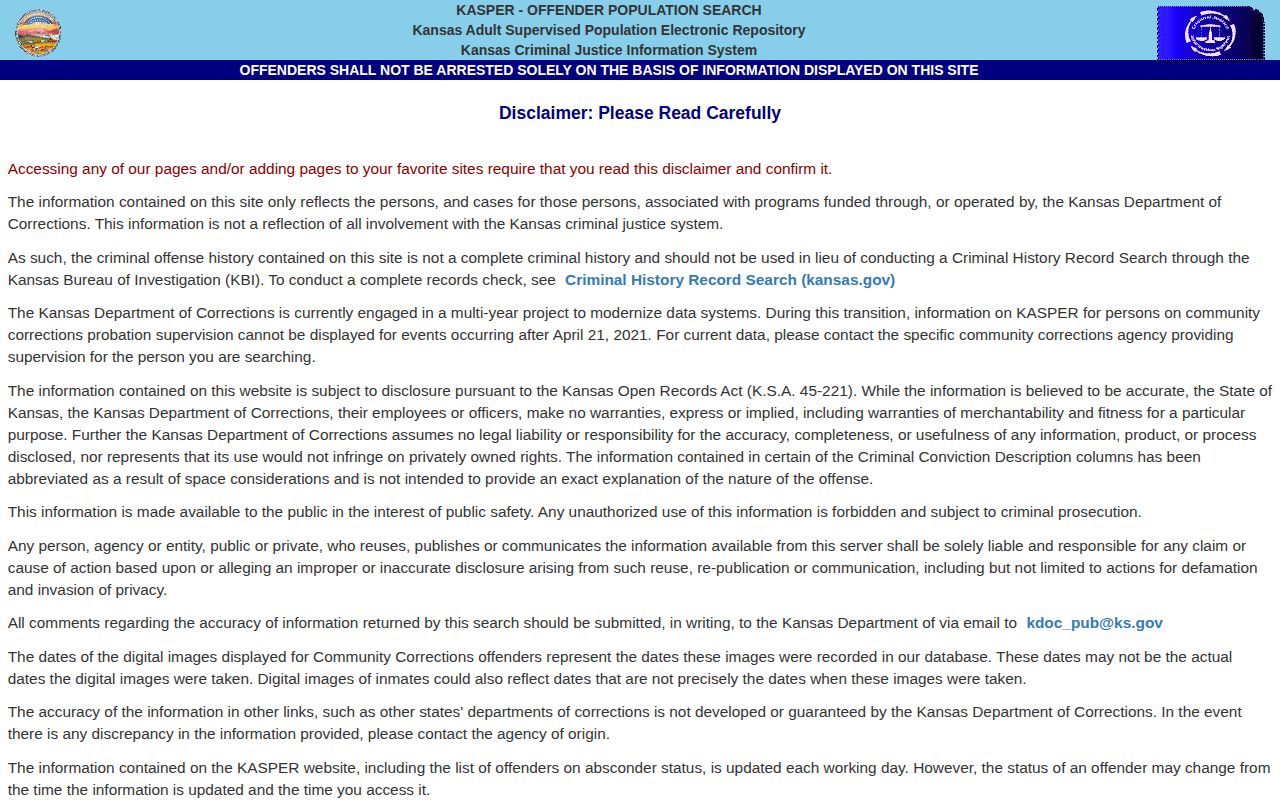
The screenshot marks the statewide search entry, while the individual detail record supplies the status, movements, and supervision context.
Barber County Recent Release Checks
The official Sheriff page publishes no 24-hour feed, 72-hour feed, booking-photo database, archive, mobile app, or official social release channel. For a recent local event, call the jail and request the named release entry under KORA. For a multi-person time window, ask whether an existing release log covers the exact dates and times. The county need not create a custom report.
Kansas VINE can provide custody information and event notifications for adults in participating county jails. It does not include KDOC offenders held in state prisons. Search the specific person in the Kansas VINELink portal, verify the agency and identifiers, and preserve the exact alert wording. Then confirm with the reporting jail because VINE is a notification layer rather than a certified historic release sheet.
State-prison notification follows a separate KDOC Victim Services process. The Kansas Bureau of Investigation registry is also separate and covers only people who meet statutory registration rules. Neither system is a general list of everyone released from Barber County custody.
Barber County Release Supervision
A person can be out of a prison or jail while still under legal supervision. Parole generally follows a Prisoner Review Board decision for an eligible sentence. Postrelease supervision follows the prison portion of many determinate Kansas sentences. Probation is imposed by a court, while community corrections is a structured court-supervision path. These terms should not be collapsed into “released.”
KASPER is the public starting point for KDOC parole and postrelease status. The Wichita Parole Office serves Barber County at 212 S. Market Street in Wichita and can help with KDOC supervision. Barber Court Services and South Central Kansas Community Corrections handle court-supervision paths. KASPER’s recent community-corrections gap means the sentencing case and responsible local agency may be more current for probation or community corrections. Detailed verification appears in Post-Release Supervision.
An absconder status means the supervising authority alleges that the person is avoiding supervision or cannot be located. It is not final discharge. When KDOC obligations end, a discharge or maximum-sentence expiration is the stronger record of completion, though unrelated cases can still exist.
Barber County Federal Release Records
The BOP Inmate Locator is the public source for a person who served a federal prison sentence, mainly from 1982 forward. Search by register number when possible or use name and available identity fields. A past release date with no location, or a “RELEASED” status, indicates that BOP custody ended. “IN TRANSIT” is not release, and “UNKNOWN” means the term or release information is undetermined. The federal docket supplies judgment and supervised-release context.
ICE’s Online Detainee Locator covers current detainees and people released from ICE custody within the prior 60 days. Search with the exact A-number and country of birth, or biographical fields. No dedicated ICE facility or contract in Barber County was verified. A “not found” result may reflect release, transfer, data issues, protected information, or other custody, so it is not a certified release record.
An ICE detainer is a request for advance notice and temporary continued custody so ICE may assume custody. It is not proof that transfer occurred. Read the Barber County release or transfer destination and then check the receiving system. The U.S. Marshals Service has no comparable public name-based release locator; use the federal docket and responsible district or facility.
Where Barber Release Records Appear
The same name can produce different results because each source covers a different population. Choose the row that matches the last custodian and the event being confirmed.
| Person or status | Correct source | Main limit |
|---|---|---|
| Current Barber County detainee | Direct jail inquiry | No official online roster is published. |
| Released local detainee | Jail release entry and Barber court case | Court order alone does not prove physical release time. |
| Transferred or released KDOC person | KASPER and KDOC records | Working-day updates; not a county-jail archive. |
| County-jail notification subject | Kansas VINE | Notification, not a certified historic record. |
| Former federal prisoner | BOP locator and federal docket | BOP status does not resolve later non-BOP custody. |
| ICE detainee or recent ICE release | ICE ODLS and ERO confirmation | Limited scope and recent-release window. |
Barber Release Records at Court
Barber County belongs to Kansas’s five-county 30th Judicial District, while the local record contact remains the Barber Clerk of District Court at 118 E. Washington in Medicine Lodge. The statewide district-court portal is the first search point. Use the Barber County filter, confirm the person and case, and review available bond, dismissal, sentencing, probation, revocation, or satisfaction events.
Remote access does not include every public document. Older converted files may be available only at a courthouse terminal, and every courthouse supplies a public terminal. The clerk is open Monday through Friday from 8 a.m. to noon and 1 p.m. to 4 p.m., with a noon closure. Sealed, expunged, juvenile, and otherwise protected records may not be available.
The portal source appears below. Open the current court records page for live access options.
The court record explains legal disposition, while the jail’s outgoing record confirms physical release or transfer.
Two Stops for Barber Release Proof
Barber County’s in-person verification route is unusually compact. The jail and Sheriff’s Office are at 124 E. Washington, while the district clerk is at 118 E. Washington in Medicine Lodge. The neighboring offices hold different evidence. The sheriff or jail record documents booking and outgoing mechanics; the court record documents bond, disposition, sentence, or another legal order.
Start with the jail when the question is the actual release time or destination. Use the clerk when the question is why the court authorized the outcome or when a public filing is not remotely available. Keep the records paired but do not treat them as interchangeable. A court order can precede processing, while the jail entry may use a short disposition label that needs the case file for legal context.
Expunged Barber Release Search Results
The Barber County Attorney page links residents to Kansas Judicial Council expungement material and identifies the local attorney contact. That local route matters when a court record may qualify for the statutory process. Expungement can limit access to arrest and court material after a court order, but it is not evidence of physical release.
Never infer expungement from an empty portal result. The cause may be spelling, remote-access limits, an older file available only at the courthouse terminal, a protected case, or no matching Barber County case. Obtain the relevant court order when expungement status matters. Separate agency records may also be governed by their own duties rather than vanishing automatically.
Two Barber Release Phone Numbers
Two official sources publish different functional numbers at the same 124 E. Washington address. KDOC’s county-jail directory gives 620-886-5678 for Barber County Jail. Barber County’s Sheriff page gives 620-930-2590 for the Sheriff’s Office and 620-886-3103 for fax. The labels explain the difference, so both main numbers should be kept rather than merged or silently replaced.
Use the jail number for a custody or release-status question. The Sheriff’s Office number can confirm the current records-request delivery method and office routing. Neither number guarantees that staff will disclose every detail by phone. A written booking or release record remains the stronger source when the exact date, time, and disposition must be documented.
Barber County Release Facility
Barber County Jail is the only local detention facility verified in the Facility Map. It is operated under Barber County and Sheriff authority, not KDOC. No state prison, BOP prison, dedicated ICE center, or U.S. Marshals facility was identified inside Barber County. That physical map does not prevent a Barber defendant from entering one of those systems after transfer.
A community release from the jail should be confirmed with its booking and release record. A KDOC transfer leads to KASPER after intake. Another county or federal transfer follows the receiving agency. No official release-processing hours, exit point, property-return procedure, roster, recent-release feed, or archive duration was published, so none should be assumed.
Public Record Search
Sponsored Results